After the Final Curtain: A Record Worth Keeping
A concise production record preserves decisions, useful materials and lessons so the next team can reuse what worked and avoid repeating costly discoveries.
The common mistake in a production record is trying to preserve everything. The resulting folder can bury a useful lesson about a venue, a design choice or a failed workaround beneath routine correspondence. A concise production record should help the next team make better decisions, not reconstruct every rehearsal.
Give it a narrower job than the project archive: retain what the production taught the organisation, and why that lesson may matter again. The distinction keeps the record focused on learning rather than becoming another place to store the same files.
Which lessons will matter to another production?
Choose lessons that connect a specific condition to an observable consequence. “The audience entered through the foyer while another event was clearing” gives a future producer something concrete to check. “Allow more time” is too broad to guide a decision in a different venue.
For each lesson, write what happened, what followed and what someone might consider next time. Include successful practices as well as problems, but state the conditions that made them useful. A rehearsal-room layout that clarified a complex transition is worth noting if you describe the arrangement and what it helped the team see.
Keep judgements separate from observations. “The transition felt long” records an impression; “remove the scene change” proposes an action. Mark the difference so a future team can assess the suggestion against its own cast, venue and artistic aims.
How can lessons stay distinct from the project archive?
The archive holds the fuller record: correspondence, meeting minutes, rehearsal notes and working versions. The legacy note should point to a source when it explains a significant choice, but it need not duplicate the source material. Its particular value is the explanation that would otherwise be hard to infer from a folder of files.
For each retained lesson, identify the relevant production or department, the circumstances, the outcome and any caveat. Avoid turning one team’s workaround into a standing rule. If an arrangement depended on a particular room or supplier, say so; the next production can then judge whether the lesson applies.
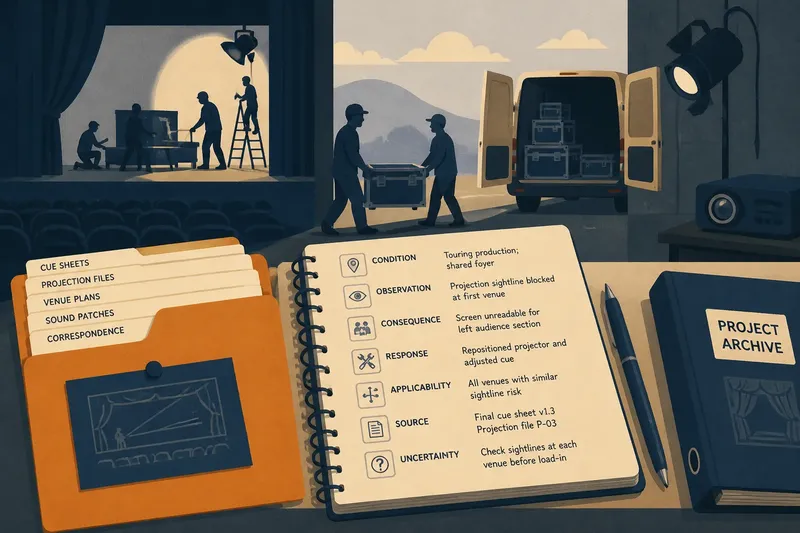
Say you are documenting a small touring production with a hired van, a venue-owned projector and a revised sound cue. The team’s notes show that the cue changed after a sightline problem at the first venue, while the projector was supplied locally. Record those observations and the resulting lesson: confirm projection sightlines at each venue, and check locally supplied equipment before relying on it. Link to the final cue sheet and projection file in the archive rather than copying the whole working folder. The next producer can see what prompted the change, what may transfer and what needs local confirmation.
What should a useful lesson record include?
Use a small set of fields to make each entry legible without turning it into a form-filling exercise. Every item should help a reader understand the observation and decide what to do with it.
- Condition: Check what circumstance shaped the work, such as a shared foyer or restricted access; if it is likely to recur, flag it for early planning, otherwise keep it as context.
- Observation: Check that the entry describes something seen or confirmed rather than an assumption; if supported by the production record, retain it as a lesson, otherwise label it uncertain or leave it out.
- Consequence: Check what changed for the audience, crew or schedule; if the effect was material, explain it, otherwise avoid inflating a minor inconvenience into a general warning.
- Response: Check what the team actually did; if it addressed the problem, record it as a possible option, otherwise describe the limitation and do not recommend it.
- Applicability: Check which venues, departments or production types share the relevant conditions; if a future team may face them, flag the lesson for review, otherwise leave it as production-specific context.
- Source: Check that a reader can locate supporting material, such as a final cue sheet or venue plan; if access works, link to it, otherwise identify the archive location and ask the archive owner to resolve access.
- Uncertainty: Check whether a matter remains unresolved or depends on confirmation; if so, label the open question and who can clarify it, otherwise state that the point was settled for this production only.
How should the record handle sensitive or uncertain material?
Do not turn a process lesson into a verdict on an individual. “The revised information reached front of house after printed copies were prepared” identifies a gap; blaming the colleague who sent it adds little and may make the record less useful.
Record what is known, what is inferred and what remains open. If a future remount depends on confirmation from a venue, rights holder, supplier or performer, say that plainly rather than allowing a guess to harden into an apparent decision.
Keep only material the organisation is entitled and able to retain. Copyright, performer permissions, personal information and venue agreements can affect what may be stored or shared. Follow the relevant contract and organisational policy, and seek qualified advice when the position is unclear.
How do you review a production record without rebuilding the archive?
Ask a colleague who understands the production but did not draft every entry to read it for missing context, unexplained abbreviations and claims that sound more certain than their sources. Then check that each lesson has a clear condition and consequence, and that links lead to the intended material.
Remove duplicated explanations and details that do not help someone understand or apply a lesson. Keep the full correspondence and working notes in the project archive, following the organisation’s retention practices. Put the record where future teams are expected to look, and use a clear production title so it can be found without knowing who filed it.
Which questions help keep the record useful?
Should the record include every production meeting?
No. Keep meeting minutes in the project archive and point to a particular discussion only when it explains a consequential lesson. A record of learning does not need a transcript of how the team reached every decision.
How much detail should each lesson contain?
Include the condition, what happened and what followed, then add a caveat if the lesson depends on a particular venue or arrangement. That gives the next team enough context to judge relevance without prescribing a universal rule.
Should old working files be deleted?
Do not delete files just to make the record look tidy. Follow the organisation’s retention practices and permissions, then point to the relevant archive material instead of copying a whole folder into the legacy note.
Who should review the record before it is filed?
Choose a colleague familiar with the production who can question unclear wording without reopening every artistic choice. They should check whether observations, interpretations and proposals are distinguishable and whether the intended readers can reach linked sources.
When is a production record ready to file?
It is ready when a future colleague can understand the useful lessons, see the conditions behind them and distinguish settled observations from open questions. The record need not answer every possible query; its limits should be clear enough that nobody mistakes a local workaround for settled practice.
Use the phrase concise production record to describe a document that preserves learning rather than the whole production’s communication trail. Put it in the organisation’s recognised archive, with a clear route to the fuller project files. That leaves the next team with evidence to consider, not a second show to manage.