The Production Schedule Is a Map, Not a Promise
A production schedule links tasks, handovers and dependencies so a live show team can see what can proceed, what must wait and who needs to act next.
The common mistake with a production schedule is treating its dates as promises. That can turn a useful planning tool into a source of blame: a late lighting plot looks like one person’s failure, even if the design decision it depends on is still open. A production schedule works better as a shared map of dependencies, handovers and decisions that may need to move.
That distinction matters from the first venue conversation to the final technical rehearsal. A date says when work is expected; a dependency explains what must happen before it can. The schedule becomes useful when the team can see both, and tell which tasks are firm, which are estimates and which need a decision.
What should a production schedule show?
At its simplest, a production schedule is a dated view of the work required to bring a performance into the room and present it. It may include venue access, design deadlines, build and hire decisions, rehearsal periods, technical work, approval points, public performances and the get-out. Its job is not to list every small action. It is to show the work whose timing affects other people.
A practical entry identifies an owner, an expected handover and what the next task needs. “Sound design due” is less useful than “sound designer sends playback requirements to the production manager, so the venue can confirm connections and equipment”. The second version reveals the relationship; if the handover slips, the next person can see why it matters.
Use a shared calendar or a production tool such as Asana, Trello or Microsoft Project if it suits the team’s working habits. The software matters less than a consistent way to mark status, owner and dependency. A beautifully formatted schedule that nobody updates is a decorative form of fiction.
Which scheduling approach fits the show?
There is no single useful level of detail for every production. A small touring performance, a new work with changing design decisions and a venue-led event have different kinds of uncertainty. Three approaches are common; they can be combined, but one should lead.
Is a milestone schedule enough?
A milestone schedule records the points that matter to the whole team: venue confirmation, design sign-off, rehearsal start, technical access and opening. It suits a compact production with a stable creative plan and a small team that can coordinate routine work directly. Its weakness is that it shows little of the route between milestones, so it can conceal a handover with no clear owner.
Use this approach when the work between dates is familiar and manageable without a detailed shared plan. If several departments must complete linked work before a milestone, add those dependencies rather than relying on everyone to infer them.
When does a dependency-led schedule help?
A dependency-led schedule shows how tasks connect: one item cannot begin, or cannot be completed properly, until another is ready. It suits productions with several departments, external suppliers or decisions that affect design, build and rehearsal in sequence. It makes the consequences of a change easier to discuss because the team can trace what else may need attention.
Its cost is maintenance. If every minor action is entered, owners spend more time tending the schedule than doing the work. Keep it focused on handovers and decisions that could affect another task, department or venue access.
Should the schedule use rolling planning?
Rolling planning gives near-term work more detail and leaves later work at a broader level until the relevant decisions are clearer. It suits a developing production where design or content is still evolving, while the team still needs a workable picture of the next handovers. It avoids false precision: a provisional task remains provisional rather than acquiring a confident-looking date because a blank cell feels uncomfortable.
The approach requires regular review. If the team does not revisit the later plan, “we will detail it later” can become a way to miss a decision until it is urgent. Make each review produce a clear change, confirmation or named follow-up.
How do dependencies change the plan?
A dependency is a relationship between pieces of work, not merely a row that appears above another. Some tasks can run alongside each other. Others need a decision, handover or physical condition first. The schedule should make the distinction visible, particularly where an owner is waiting on information from someone else.
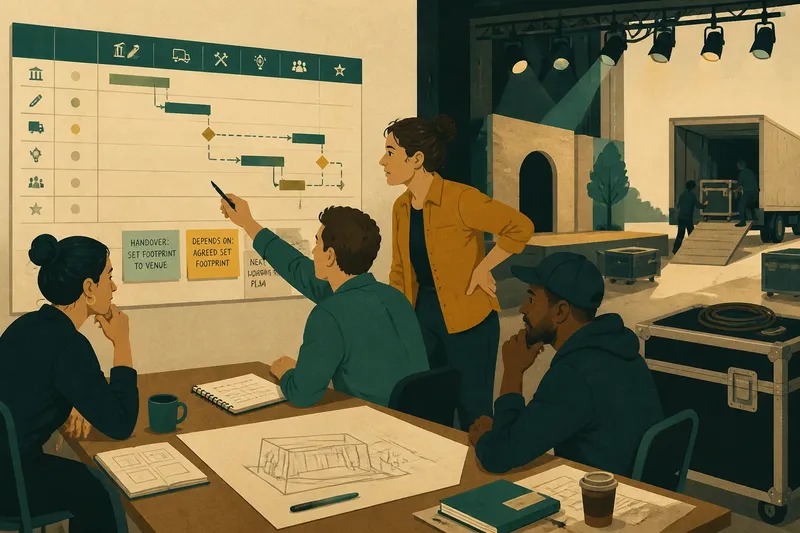
Say a small theatre company is planning a touring show and the set design is still being revised. The production manager records that the venue’s loading and storage plan depends on the agreed set footprint, while rehearsal planning can continue using the current draft. If the design decision moves, the team can see which venue conversation needs a new date and which work can carry on; the schedule has exposed a choice, not predicted the future.
For each important link, ask what is being handed over, who receives it and what they need to do next. “Design finished” may mean a drawing is approved, a specification is issued or a supplier has enough information to proceed. Naming the actual handover prevents two people from assuming the other has completed the same task.
How should dates and changes be handled?
Give dates an honest status. A confirmed venue access date is different from a target for receiving a draft, and both differ from an estimate used to plan the next conversation. Labels such as confirmed, target and provisional are more informative than a colour unless everyone knows exactly what the colours mean.
When a task moves, update the schedule and describe the impact in plain language. Note the new expectation, the affected handover and the person responsible for the next decision. Avoid silently shifting every later date to preserve a tidy sequence; some work can move independently, while other tasks may need a decision about scope, resources or timing.
Set a review rhythm that matches the pace of the production. The team may look at the schedule during a regular production meeting and check urgent handovers separately. The aim is not to hold a meeting for every date change. It is to ensure that people who rely on a changed task hear about it before they plan around the old version.
What should a production schedule help you decide?
A schedule earns its place when it helps the team make a choice, not just observe that time is passing. Use these checks to decide what to update and who should act.
Which task is blocking another?
Follow the handover from the task that is waiting back to the information or decision it needs. If there is no named owner for that input, assign one before adding more dates.
Which date is confirmed?
Separate commitments from targets and estimates so nobody treats a planning assumption as a venue agreement. If the distinction is unclear, ask the person with authority to confirm the date.
What can continue while a decision is pending?
Identify work that can proceed without creating avoidable rework. Record any limits, such as using a draft layout for rehearsal planning while holding off on a supplier order.
Who needs to hear about a change?
Trace the affected handovers and tell the people who own the next tasks. A change recorded in a tool is not shared merely because the tool has a login page.
How do you choose the right level of detail?
Start with the team’s dependencies, not a template. If the main risk is remembering a handful of shared dates, a milestone view may be enough. If departments are waiting on one another, use a dependency-led schedule. If key decisions are still unfolding, keep near-term work specific and later work provisional.
Then check whether the people named as owners can update and use the plan. A schedule maintained only by the production manager may suit a small team, but the manager needs a reliable route for collecting changes. For a larger team, agree who updates each part and how significant changes are communicated.
Keep the schedule separate from the work itself: it points to a decision, handover or deadline, but does not replace the conversation needed to resolve them. A production schedule is most valuable when it helps everyone see where the show can keep moving, where it must wait and what needs a human decision next. Treat it as a map, and a changed route becomes something to manage rather than a broken promise.